Something has quietly changed about how people find information online, and if you haven't adjusted your site strategy yet, you are already behind. A growing number of searches no longer end with someone clicking a blue link. They end with an AI chatbot delivering a complete, synthesized answer, citing two or three sources, and sending the user on their way. Your site may never appear at all.
This is the new reality that Generative Engine Optimization, or GEO, is built to address. Where traditional SEO earns you a ranking on a results page, GEO earns you a citation inside an AI-generated answer. The two are related, but they are not the same thing, and the gap between them is growing fast. Research tracking overlap between top Google rankings and AI citation sources has found that overlap has dropped from around 70 percent two years ago to below 20 percent today. Ranking well on Google no longer guarantees you will show up in ChatGPT, Perplexity, or Google's own AI Overviews.
The good news is that this is a solvable problem. Here is what GEO actually is, why it matters for your site right now, and the specific technical and editorial steps you need to take to start appearing in AI search results.
Generative Engine Optimization is the practice of structuring, writing, and publishing content so that AI-powered answer engines choose it as a trusted source when generating responses to user queries. The term was introduced by Princeton researchers in 2023 and has become one of the most urgent topics in the webmaster and SEO community heading into 2026.
The distinction from traditional SEO is important to understand. When someone types a query into Google, the algorithm ranks pages and presents a list of links. The user chooses which one to click. With AI answer engines like ChatGPT, Perplexity, Google AI Overviews, and Microsoft Copilot, the process is fundamentally different. The AI reads multiple sources, synthesizes a response, and may or may not cite where that information came from. You are not competing for a click. You are competing to be the source the AI trusts enough to reference.
That shift changes the optimization game considerably. Keyword density and meta descriptions matter far less in this context. What matters instead is content structure, entity clarity, verifiable authority signals, and whether your pages are written in a way that AI systems can efficiently retrieve and understand.
Before anything else, you need to verify that AI crawlers are not being blocked from your site. This sounds obvious, but it is one of the most common and consequential mistakes webmasters are making right now, often without realizing it.
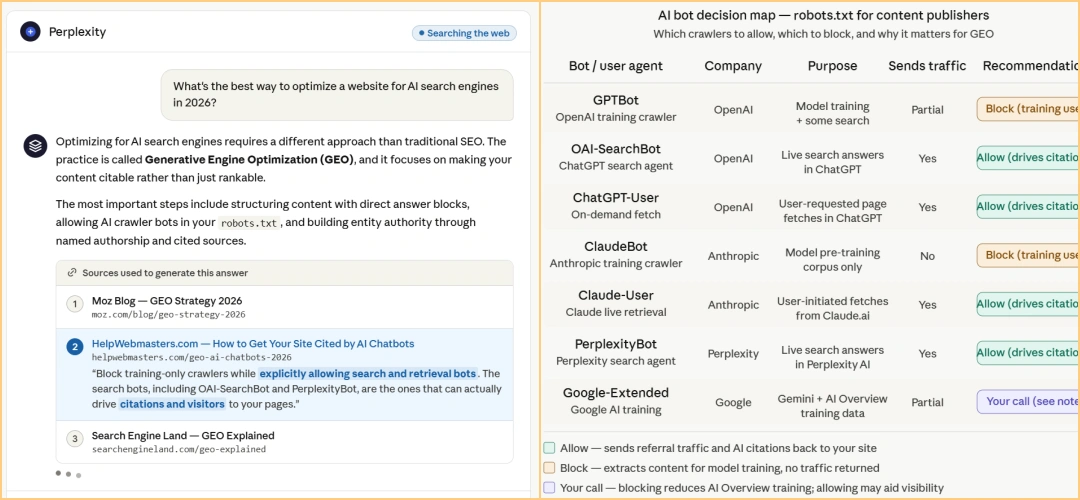
Your robots.txt file controls which bots are allowed to crawl your pages. In 2026, there are at least a dozen active AI crawler user agents you need to be aware of, and they fall into two distinct categories: training bots that feed model development, and search or retrieval bots that drive actual citation traffic back to your site.
The strategic approach most publishers are adopting is to block training-only crawlers while explicitly allowing search and retrieval bots. The training crawlers, including GPTBot (OpenAI's training agent), ClaudeBot (Anthropic's training crawler), and Meta-ExternalAgent, consume your content to improve AI models but do not send referral traffic in return. The search bots, including OAI-SearchBot (which powers live ChatGPT search results), PerplexityBot, and Claude-User, are the ones that can actually drive citations and visitors to your pages.
One important note: blocking GPTBot and blocking OAI-SearchBot are two separate actions requiring two separate directives. Many webmasters block one assuming they have handled both, and that assumption is wrong. If you want to appear in ChatGPT search answers while protecting your content from training use, you need to explicitly allow OAI-SearchBot while disallowing GPTBot.
Also worth knowing: if your site uses Cloudflare, check your configuration carefully. Cloudflare updated its default settings to block certain AI bots automatically, which means your site may be invisible to AI crawlers right now without any deliberate action on your part.
A basic starting-point configuration for a content publisher trying to maximize AI citation visibility while limiting training use would look like this in your robots.txt:
User-agent: GPTBot
Disallow: /

User-agent: ClaudeBot
Disallow: /

User-agent: OAI-SearchBot
Allow: /

User-agent: PerplexityBot
Allow: /

User-agent: Claude-User
Allow: /
Review the official documentation for each crawler, as user agent strings can change, and always verify your configuration is working by checking your server logs for actual crawl activity.
Once your site is accessible to the right bots, the next layer of GEO work is editorial and structural. AI systems retrieve and synthesize content differently than human readers do, and writing for AI discoverability requires some deliberate adjustments to how you format your pages.
The single most impactful structural change you can make is writing direct, self-contained answer blocks near the top of your content. When an AI breaks a user's query into sub-questions and searches for answers, it is looking for passages that clearly state a position or explanation in 130 to 170 words without requiring context from surrounding paragraphs to make sense. Think of it as writing for someone who will read only one paragraph of your page and needs to walk away with a complete, accurate answer.
Use question-style headings wherever it is natural to do so. Headings like "What is GEO?" or "How do I update my robots.txt for AI crawlers?" mirror the conversational query formats that AI systems process. These heading patterns make it significantly easier for retrieval systems to match your content to specific user questions.
Adding a structured FAQ section to your key pages is one of the highest-impact GEO tactics available right now, particularly when paired with FAQPage schema markup in JSON-LD format. This combination signals to both Google's AI Overviews and third-party AI search engines that your page contains structured, question-and-answer content that is designed to be cited directly.
The "Frankenstein's Plugin" Survival Guide: Keeping Your WordPress Site Alive
Most AI crawlers also do not execute JavaScript. If your content is rendered client-side through a JavaScript framework and is not available in the page's initial HTML, it may be invisible to AI retrieval systems regardless of how good it is. Test your pages with JavaScript disabled to confirm your core content loads in the raw HTML.
Content structure gets you in the door, but entity authority is what makes AI systems consistently choose your site as a citation source. This is the GEO equivalent of domain authority in traditional SEO, and it is built through a combination of on-site and off-site signals.
Research consistently shows that ChatGPT has a strong preference for encyclopedic and formally documented sources. Wikipedia and Wikidata presence accounts for a significant share of top ChatGPT citations. If your brand, organization, or key subject matter experts have Wikipedia entries or Wikidata records, that is a meaningful credibility signal. If they do not, building toward that through press coverage, academic citations, and third-party documentation is a worthwhile long-term investment.
Named authorship with verifiable credentials matters here more than it does in traditional SEO. Author bio pages that link out to LinkedIn profiles, published work, institutional affiliations, or professional credentials help AI systems confirm that the expertise behind your content is real. Anonymous or byline-free content is structurally harder for AI to trust and cite.
Statistics, citations, and expert quotes embedded in your content also improve AI citation rates meaningfully. Princeton research on GEO found that content including cited sources, data points, and quotations from named experts performed 30 to 40 percent better in AI visibility compared to unoptimized content covering the same topics. This makes intuitive sense: AI systems are looking for content that has already done the verification work, so the presence of verifiable references within a piece functions as a quality signal.
A newer addition to the GEO toolkit is the llms.txt file, a lightweight plain-text file placed at the root of your domain that provides AI agents with a structured summary of your site's most important content and how it is organized. Think of it as a sitemap designed specifically for large language models rather than traditional search crawlers.
Adoption is still relatively low, with current estimates putting uptake at around 10 percent of domains. That makes it a genuine early-mover opportunity. The file requires minimal technical effort to implement and serves as an explicit signal to AI retrieval systems about where your highest-value content lives. For webmasters publishing in a specific niche or building topical authority around a defined subject area, it is a low-risk, potentially high-return addition to your AI SEO strategy.
Traditional analytics tools were not built to track AI citation performance, which means most webmasters have limited visibility into how their site is performing across AI platforms. This is changing, but the tooling is still maturing.
The most practical starting point is tracking direct and referral traffic from AI platforms in your analytics. Perplexity, ChatGPT, and some other AI tools do generate referral traffic that shows up in standard analytics when users click through to your site from a cited source. Monitoring that referral data over time gives you a directional read on whether your GEO efforts are translating into actual visits.
Beyond that, manual spot-checking is still the most accessible method for most independent webmasters. Query ChatGPT, Perplexity, and Google AI Overviews directly for the topics your site covers and observe whether your site appears as a cited source, whether your brand is mentioned without a link, or whether you are absent entirely. Document this over time as a baseline you can measure improvement against.
More sophisticated tracking tools that monitor AI visibility metrics and share of voice across AI platforms are emerging from companies like Semrush, and they are worth watching as this space matures.
GEO is not replacing SEO. Traditional search still drives significant traffic, and the fundamentals of building a credible, well-structured, authoritative site remain the foundation everything else is built on. In fact, data consistently shows that strong Google rankings are still the entry ticket for AI citation visibility, with the vast majority of AI Overview citations coming from pages that already rank in the organic top 10.
But SEO alone is no longer sufficient. The webmasters who will maintain strong visibility over the next several years are the ones who understand that AI-referred traffic is a growing, high-converting channel that requires its own set of optimization strategies. Getting your robots.txt right, structuring content for retrieval, building entity authority, and writing direct answer-ready content are the four pillars of a GEO strategy that actually works.
The AI platforms are already deciding whose content to cite. The question is whether your site is positioned to be one of the sources they trust.