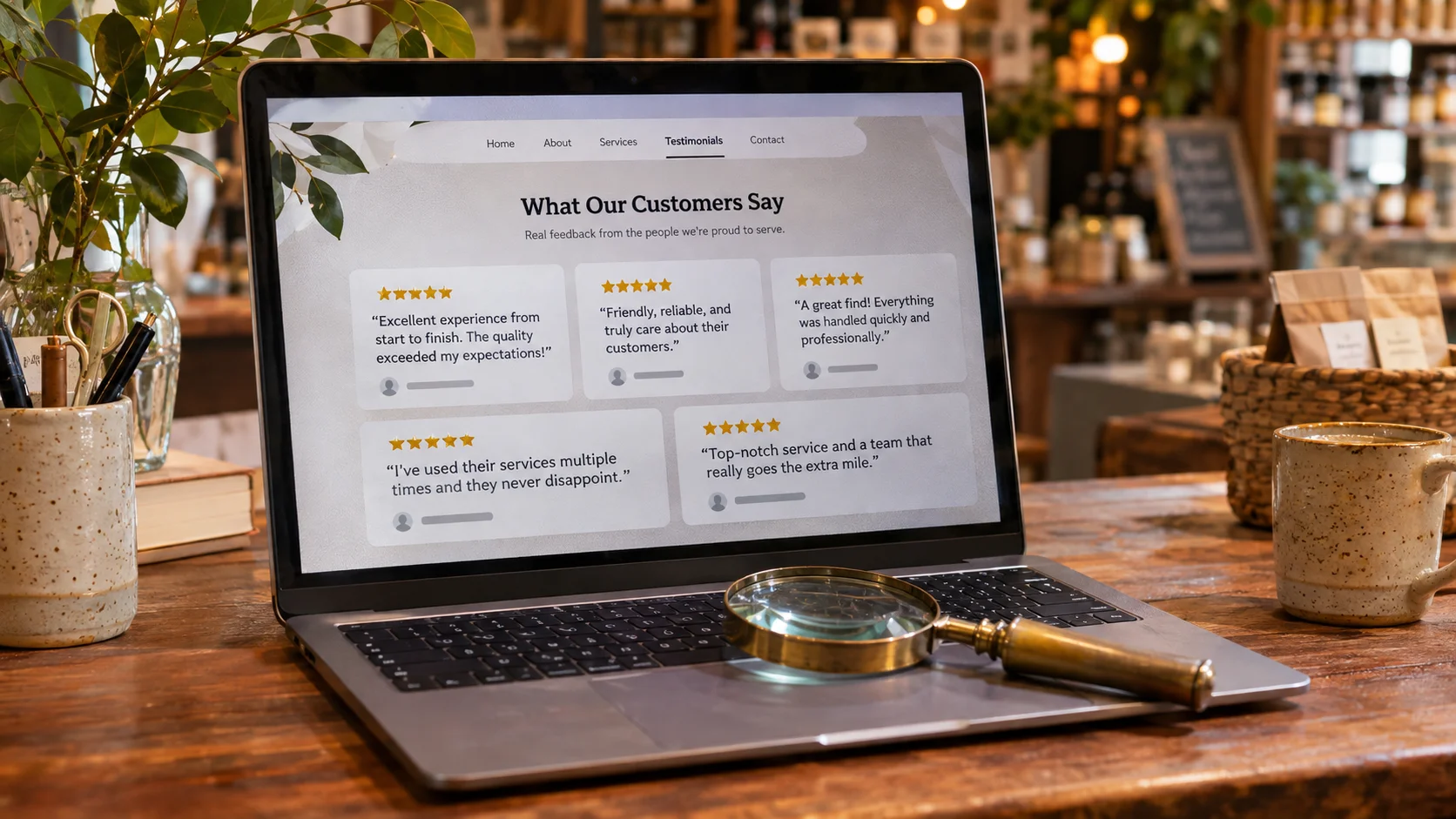
Most small business websites have a page that nobody thinks about as legal territory, a scroll of five-star quotes, a rotating carousel of first names and towns, maybe a Google or Facebook widget pulling in the latest ratings. It reads as social proof, the digital version of a framed thank-you card by the register, and it usually gets built in an afternoon by whoever set up the site.
The Federal Trade Commission sees that page differently. In its published questions and answers on the consumer review rule, the agency states that a business that puts testimonials on its own website "is disseminating them and is not merely 'hosting' them," and that once consumer reviews are featured in marketing, "consumer reviews become testimonials." The page is advertising, and the business owns every claim on it.
Unlike previous guidance, the FTC's Consumer Reviews and Testimonials Rule (16 CFR Part 465), in effect since October 21, 2024, gives the agency explicit authority to issue civil penalties. Meanwhile, Google applies a separate rule set to the exact same page, deciding whether those reviews earn rich star snippets in search listings.
What the Federal Rule Bans
The text of Part 465 is short, and its sections map neatly onto the ways small businesses get into trouble. Section 465.2 covers fake or false reviews and testimonials, including those attributed to people who do not exist or who never used the business. The FTC's announcement made clear that AI-generated reviews fall inside that definition. Section 465.4 bars paying or otherwise rewarding people for reviews conditioned on a positive or negative sentiment.
Section 465.5 targets insider reviews. The FTC's August 2024 announcement said the rule prohibits reviews and testimonials written by company insiders that fail to clearly and conspicuously disclose the giver's material connection to the business, and that it prohibits such reviews from officers or managers outright. The remaining sections cover company-controlled review websites presented as independent, review suppression through threats or groundless legal claims, and buying or selling fake social media indicators such as bot followers.
The suppression section reaches further than many site owners assume. It also bars a business from implying that its on-site reviews represent all or most of those submitted when some were held back for their ratings or negative sentiment. That describes exactly how a lot of hand-curated testimonials pages are assembled.
Knowledge, and What a Violation Costs
The fake review provisions apply when a business knew or should have known the content was fake or false. The FTC's Q&A says the rule authorizes courts to impose civil penalties for knowing violations. Under 16 CFR 1.98, the penalty for a violation of an FTC trade regulation rule stands at $53,088, a figure applied to penalties assessed after January 17, 2025. A Federal Register notice published September 15, 2026 confirmed the agency's civil penalty amounts will remain unchanged during 2026, so the 2025 level still governs.
The count is per violation, which is why a page with dozens of fabricated quotes is a very different exposure from a page with one sloppy one.
How the FTC Has Used It So Far
Enforcement has been measured rather than sweeping. On December 22, 2025, FTC staff sent warning letters to 10 companies, which the agency did not name. The letters warned that violations could lead to a federal lawsuit and civil penalties of up to $53,088 per violation. The published letter template asks recipients to cease any noncompliant conduct, to email the agency within five business days, and lists among its suggested remedies "removing potentially problematic reviews and testimonials from websites under your control."
"Fake or false consumer reviews are detrimental to consumers' ability to make accurate and informed choices," said Christopher Mufarrige, Director of the FTC's Bureau of Consumer Protection, when the letters went out. "As consumers increasingly depend on online reviews, the FTC is committed to ensuring companies comply with this Rule."
The first lawsuit to lean on the rule followed on May 11, 2026, when the Department of Justice, acting for the FTC, and the state of Illinois sued Premium Home Service and its owner, Yosef Bernath. The complaint alleges the company created thousands of fake home-repair business listings and fabricated five-star reviews, including reviews written or solicited from employees and relatives, and it charges violations of the review rule alongside other federal and state claims.
Home services sit at the center of that case for a reason. Local trades live and die on review volume, which is exactly the pressure that tempts an owner to ask a cousin, a crew lead or a friendly supplier for a quick five stars.
Gating, Incentives and Family Members
The gray areas are where most honest businesses wander, and the FTC has answered several of them in writing. Asked whether a business can request reviews only from customers it believes are happy, the agency's Q&A says the rule "does not contain a specific prohibition against such conduct," then adds that the practice could still violate the FTC Act. Its Endorsement Guides, revised in 2023 at 16 CFR Part 255, walk through a scenario where a marketer invites only its most satisfied buyers to post on third-party sites. The guides conclude that the practice may be unfair or deceptive if it leaves the posted reviews substantially more positive than they would otherwise be.
The same guides describe the clean version: inviting all recent purchasers to leave a review would not have been unfair or deceptive, even if the business openly hoped for positive ones. On incentives, the Q&A says the rule does not prohibit them as long as there is no express or implied requirement that a review express a particular sentiment. Family members may leave reviews, but the agency asks that they clearly and conspicuously disclose the relationship.
The guides also flag a retailer that suppresses or declines to publish any review below four stars as misleading. For a testimonials page, that is the practical test: if the page shows only the glowing feedback, it should not suggest it represents everyone.
The Stars Google Will Not Show
Separate from federal law, Google sets its own terms for the star ratings that appear under a search result, and those terms rule out most testimonials pages. Since September 16, 2019, when Google Search Central announced a change to review rich results, reviews that a business places about itself have been treated as self-serving and no longer displayed for businesses and organizations.
The current review snippet documentation states that when the entity being reviewed controls the reviews about itself, its pages using LocalBusiness or other Organization structured data are ineligible for star reviews. It names the embedded widget case directly, citing Google Business reviews and Facebook review widgets as examples. Pasting a widget onto the homepage and wrapping it in review markup will not earn stars, and markup that violates the policy can draw a manual action.
That rule sits alongside Google's earlier retreat from FAQ rich results, which we covered in our explainer on what to do after Google removed FAQ rich results. The pattern across both changes is that structured data describing a business's own praise of itself has stopped paying off in search.
What a Clean Testimonials Page Looks Like
Customers still read the page. BrightLocal's Local Consumer Review Survey, published in February 2026 from a sample of 1,002 U.S. adults, found that 97 percent of consumers read reviews for local businesses and 74 percent look for reviews written in the last three months. Nearly half, 47 percent, will not use a business with fewer than 20 reviews. The same survey found 97 percent think businesses should face punishment for fake reviews.
A defensible page starts with provenance. Every testimonial should trace to a real customer who agreed to be quoted, with the original email, survey response or platform review saved where the owner can find it. Each quote should be dated so readers can see it is current. Staff, relatives and business partners either stay off the page or appear with their relationship stated in the same line as their words.
The request process matters as much as the display. A follow-up email to every customer after a job, linking to the business's Google or Yelp profile with no condition attached to any discount, matches the clean scenario in the Endorsement Guides. A two-step survey that routes only five-star responders to the public review link matches the risky one.
Language on the page should match what it shows. A heading such as "Selected comments from customers" is honest about curation, while "What our customers say," sitting above twelve hand-picked raves and a hidden backlog of complaints, edges toward the representation the rule addresses. Linking out to the full third-party profile lets visitors check the whole record themselves.
Generated text is the newest trap. Asking an AI writing tool to "punch up" a customer's two-line comment into a polished paragraph turns a real review into one that no customer wrote, and the FTC has already said fabricated AI reviews count as fake. The same caution applies to on-site chatbots that summarize what customers think, a risk we laid out in our guide to website chatbot liability.
None of this is legal advice, and a business facing a specific complaint should talk to a lawyer. For the owner who simply wants the page to keep working, the checklist is short: real customers, saved sources, disclosed connections, an open invitation to everyone, and no star markup on reviews the business controls.