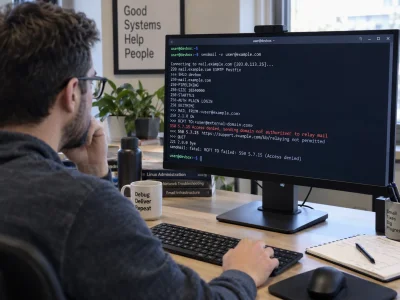
The message that wakes a solo site owner at two in the morning is almost never the one that matters. It is a monitoring ping from a checkout page that timed out for four seconds in Frankfurt, or a plugin update notice, or a security digest listing eleven advisories for software the site doesn't run. The webmaster reads it on a phone, decides it can wait, and goes back to sleep having taught themselves one more time that alerts can be ignored.
That habit is measurable and it has consequences. In a February 2026 survey of 1,039 engineers and operations professionals, 77 percent of on-call teams said they receive at least ten alerts a day, 57 percent said fewer than 30 percent of those alerts are actionable, and 83 percent admitted they ignore or dismiss alerts at least occasionally. Forty-four percent had lived through an outage traced to an alert that was suppressed or ignored.
The answer for a one-person operation is not more vigilance, because vigilance is the resource already exhausted. It is deciding, deliberately, which failures the system should handle on its own, which ones should wake a human, and which ones the platform will never catch no matter what you configure. Getting that division right is the difference between automated WordPress maintenance that protects a site and a notification stream that trains you to look away.
The Clock You Are Actually Racing
Patchstack's State of WordPress Security in 2026, published in February and covering calendar year 2025, counted 11,334 new vulnerabilities in the WordPress ecosystem, a 42 percent increase over the 7,966 recorded in 2024. High severity entries rose 113 percent to 1,966. Ninety-one percent of the year's vulnerabilities sat in plugins, nine percent in themes, and six in core, all of those rated low priority.
Two numbers from that report set the pace a solo operator has to match. Forty-six percent of the vulnerabilities disclosed in 2025 had no patch available at the moment of disclosure, and the median time from public disclosure to mass exploitation was five hours. A finer breakdown reported by The Repository put 20 percent of heavily exploited vulnerabilities inside six hours of disclosure, 45 percent inside a day and 70 percent inside a week.
Five hours is shorter than a night's sleep, which settles the question of whether manual patching is a viable strategy for a person who also has clients, invoices and a life. Hosting-layer defenses do not close that gap either. Patchstack's testing found that its host-level protections blocked 26 percent of generic exploit attempts and only 12 percent of known-exploited ones, and a separate case study across five hosting providers found that 87.8 percent of plugin exploits sailed past hosting defenses and were stopped, if at all, at the application layer.
Network-level WAFs are too generic with their protection, missing WordPress-specific vulnerabilities almost completely, and server-level security solutions mostly focus on post-exploitation. There's a huge blind spot on application security, and WordPress is a hard platform to protect when vulnerabilities can surface from any plugin.
That is Oliver Sild, chief executive of Patchstack, explaining the case study result to The Repository. Two of the five tested hosts blocked zero of the eleven exploits thrown at them, and the best performer, a provider using the Cloudflare WAF, blocked four.
What the Platform Will Now Do Without You
WordPress has quietly built more of this safety net than most site owners have switched on. Automatic background updates arrived in version 3.7, and since 5.6 new installations have had automatic updates enabled for both minor and major core releases. Per-plugin and per-theme automatic updates arrived with a toggle in the admin in version 5.5, and the detail that catches people is that those toggles are opt in and off by default.
Version 5.2 added recovery mode, which emails the admin address a secret link when a fatal error occurs and pauses the offending plugin or theme for that session so the backend stays reachable. Version 6.3 added a temporary backup of the existing plugin or theme, moved rather than zipped into an upgrade-temp-backup folder, so a failed manual update can be restored automatically. Andy Fragen and the contributors behind that change chose moving over zipping because, as the development note puts it, zipping and unzipping are resource-intensive processes that could increase the risk of failure on low-end shared hosts.
The piece that matters most for unattended sites landed in 6.6. After an automatic plugin update, WordPress now performs a loopback request to the homepage, and if that request returns an error, core assumes a PHP fatal error in the active plugin and reverts the update, emailing the administrator. The merge proposal records that the feature slipped from 6.4 to 6.5 before shipping in 6.6, because active plugins kept causing update failures during testing.
Where the Rollback Stops
The check is a loopback to the homepage, and the failure it detects is a PHP fatal error. An update that leaves the homepage rendering perfectly while breaking a checkout flow, a form handler, a redirect or a layout returns a clean HTTP 200, and nothing rolls back. Core also confines the automatic rollback to plugin auto-updates rather than themes, and the 6.3 temporary backup covers failed updates only, never a return to a previous version after an update that succeeded.
Third-party tooling fills part of that gap with checks core does not attempt. ManageWP's Safe Updates, for instance, takes a restore point, verifies the target page returns 200 before proceeding, captures a screenshot, applies the update, checks the status code again and rolls back automatically on a 4xx or 5xx response, then presents a before and after screenshot for side-by-side visual comparison. Note where that sequence ends. The automatic part still triggers on a status code, and the screenshot comparison is handed to a human to judge.
Staging is the other half-measure worth understanding precisely. WP Engine's staging environments copy the database, user accounts and files, but the company's own documentation states that there is no server-side caching on staging sites and that only the current year's uploads directory is copied, and warns that copying live to staging overwrites whatever staging area already exists. A test environment missing this year's caching behavior and last year's media library is still worth having, and it is not the same site.
The One Job Automation Will Not Do For You
The 3-2-1 rule comes from a 2012 US-CERT publication by Paul Ruggiero and Matthew Heckathorn, which prescribes three copies of any important file, two different media types, and one copy stored offsite. The phrase is generally credited to the photographer Peter Krogh. What that document does not say, and what no automation product can say on your behalf, is that the backups restore.
Veeam surveyed more than 900 senior IT, security and risk leaders for its 2026 report and found 90 percent expressed confidence in their ability to recover from a cyber incident, while only 28 percent of ransomware victims fully recovered their data. Forty-four percent recovered less than three quarters of the affected data, and the average recovery came in at 72 percent.
Even the most sophisticated organizations are discovering that confidence in recovery and proof of recovery are fundamentally different capabilities.
Anand Eswaran, Veeam's chief executive, said that of enterprises with dedicated recovery teams, which makes the read-across to a one-person operation uncomfortable rather than reassuring. A companion Veeam study conducted by Researchscape found that 30 percent of respondents had permanently lost data they could not restore, and that only 28 percent of the IT professionals surveyed were using immutable backups. The remedy is a calendar entry, not a product: restore one backup to a staging environment on a fixed date each quarter and open the site.
The Part Nobody Puts in the Runbook
Simply Business surveyed 749 UK small business owners in April 2023 with Mental Health at Work and found that 33 percent had experienced burnout in the previous twelve months, 44 percent reported struggling with sleep, 73 percent took fewer than 20 days of annual leave against a statutory 28, and 40 percent did not take time off even when experiencing poor mental health. A separate survey of 1,000 US small business owners, managers and recent former owners conducted by Patriot Software through Pollfish found 53.5 percent losing sleep over the business at least a few times a week and 84.4 percent saying they had sacrificed health, relationships or mental wellbeing for it.
Those numbers describe the same operator who dismissed the two in the morning alert, and the fix for both is structural rather than personal. Alert thresholds exist to be tuned: a five-minute check interval on a free monitoring plan produces different noise than a 60-second one, and monitors that alert on a single failed check from a single region produce the false positives that teach people to ignore the real ones. Every alert that cannot be acted on at two in the morning belongs in a morning digest instead.
Sergey Katsev, a VP of engineering writing in Catchpoint's SRE Report 2025, described the outcome worth aiming at with more honesty than most vendor material manages.
This year, I received fewer incident pages. I'd love to say it's because there were fewer incidents, but that's not true.
He had changed the escalation tree so most incidents no longer reached him. A solo operator has no team to escalate to, which is exactly why the escalation tree has to be built out of automation instead: auto-updates with the loopback rollback switched on, a safe-update service holding the restore point, staging that gets used before anything touches production, and a quarterly restore test that proves the last line actually works. We watched what the alternative looks like in August, when one plugin took down a third of an agency's sites four days after a core release, and again in the supply chain incident that redefined what a maintained plugin means.
The site does not need you awake. It needs the decisions you make while you are.